How to Prepare a Declaration of Conformity (DoC) in 2025
Step-by-step guide to creating a compliant Declaration of Conformity for CE marking. Learn what information is mandatory and how to avoid common mistakes.
Thibault Helle
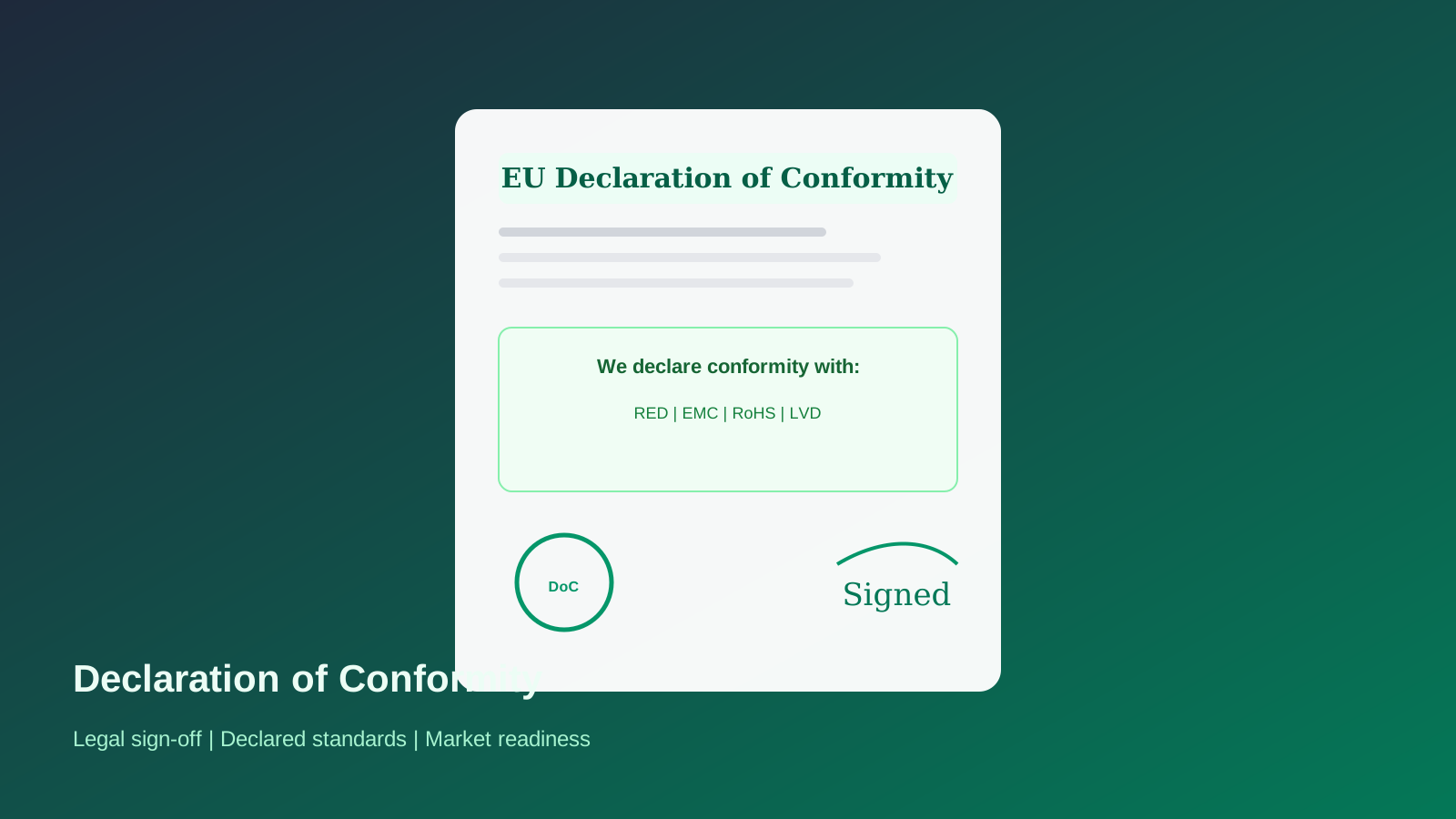
The Declaration of Conformity (DoC) is a critical document for CE marking that formally declares your product meets all applicable EU requirements. This guide shows you exactly how to prepare one correctly.
What is a Declaration of Conformity?
A DoC is a legal document where you, as the manufacturer, declare that your product complies with all relevant EU directives and harmonized standards. It must be drawn up before affixing the CE mark.
The Declaration of Conformity serves multiple critical purposes:
- Legal requirement: It is mandatory under most EU product directives
- Manufacturer accountability: You take full responsibility for product compliance
- Market access: Without a valid DoC, products cannot be legally sold in the EU
- Traceability: Links your product to its technical documentation
- Authority verification: Enables market surveillance authorities to verify compliance
The DoC is part of your technical documentation and must be kept for at least 10 years after the last unit of the product is manufactured. Market surveillance authorities can request it at any time, and failure to produce a compliant DoC can result in fines, product recalls, or market restrictions.
Legal Framework and Requirements
Different EU directives have specific DoC requirements, but all follow the principles established by the New Legislative Framework (NLF). Key regulations include:
- Decision 768/2008/EC: Common framework for marketing of products
- Regulation (EC) No 765/2008: Requirements for accreditation and market surveillance
- Individual product directives: Specific requirements for each product category
The manufacturer or EU authorized representative must issue the DoC. Importers and distributors cannot issue DoCs on behalf of manufacturers but must ensure manufacturers have provided them.
Mandatory Information in a DoC
Every Declaration of Conformity must include specific elements mandated by the applicable directives:
1. Document Identification
The DoC requires clear identification:
- Unique identification number: Use a systematic numbering system (e.g., DoC-001-2025, PRODUCT-MODEL-001)
- Document revision number: Track versions (e.g., Rev. 1.0, Version 2)
- Date of issue: Full date when the DoC was signed
- Reference to previous versions: If updating, reference superseded DoC numbers
Document identification enables traceability and version control. When products change, issue a new DoC with updated identification to maintain clear documentation history.
2. Manufacturer Details
Complete manufacturer information is mandatory:
- Full legal name: Registered company name exactly as appears on official documents
- Full address: Complete street address including building number, street name, postal code, city, and country
- Contact information: Phone, email, and website for accessibility
- EU authorized representative (if applicable): If manufacturer is based outside EU, must provide authorized representative details with same level of information
The address must be a physical location, not just a P.O. Box. Authorities must be able to contact and visit the manufacturer or representative.
3. Product Information
Precise product identification is essential:
- Product name and model number: Official product name and all model/variant designations
- Product type description: Clear description of what the product is and does
- Serial numbers or batch identification: Range of serial numbers or batch codes covered by this DoC
- Product images (recommended): Photos showing the product and CE marking placement
- Hardware/software versions: For products with firmware or software, include version numbers
The product description must be specific enough that authorities can clearly identify which products the DoC covers. Generic descriptions like "electronic device" are insufficient.
4. Compliance Statement
This is the core of the DoC, your formal declaration of compliance:
EU Directives: List all applicable directives with full references:
- Low Voltage Directive 2014/35/EU
- Electromagnetic Compatibility Directive 2014/30/EU
- Radio Equipment Directive 2014/53/EU
- RoHS Directive 2011/65/EU
- (List all that apply)
Harmonized Standards: Include complete standard references:
- EN 60950-1:2006+A11:2009+A1:2010+A12:2011+A2:2013 (with full version including amendments)
- EN 55032:2015+A11:2020
- EN 55035:2017
- EN 50566:2017
- (List all applied standards)
Additional Technical Specifications: If applicable:
- National standards used where harmonized standards don't exist
- Technical specifications that provided presumption of conformity
- Test methods and procedures followed
Always use the exact directive numbers and standard versions that were current when testing was performed and the product was designed.
5. Notified Body Information
If your product required third-party conformity assessment:
- Name and identification number: Full name of the Notified Body and their four-digit identification number (e.g., "TÜV SÜD Product Service GmbH, Notified Body 0123")
- Certificate reference numbers: EU type-examination certificates, quality system approval certificates
- Conformity assessment module used: Specify which module was applied (e.g., Module B + Module C, Module H)
- Certificate validity dates: Include issue and expiry dates of certificates
You can find Notified Body identification numbers on the EU NANDO database. Always verify the Notified Body is authorized for your product category and directive.
6. Authorized Signature
The DoC must be signed by an authorized person:
- Name and title of signatory: Full name and position of the person signing (must have authority to commit the company)
- Place and date of signature: City/country where signed and complete date
- Physical or digital signature: Handwritten signature on paper or qualified electronic signature for digital DoCs
The signatory must have authority to make legal declarations on behalf of the company. This is typically:
- Managing Director / CEO
- Technical Director
- Quality Manager with documented authority
- Authorized Representative
Never allow unauthorized personnel to sign DoCs. Keep records of who has signing authority.
How to Create a DoC: Step-by-Step
Follow this systematic process to create a compliant Declaration of Conformity:
Step 1: Identify Applicable Directives
Actions:
- Review product characteristics, functionality, and intended use
- Consult the Blue Guide to identify which directives apply
- Check directive scope and definitions
- Consider all aspects: electrical safety, EMC, wireless, materials, etc.
- Document your analysis and conclusions
Common combinations:
- Electrical products: LVD + EMC + RoHS
- Wireless products: RED + RoHS (RED includes electrical safety and EMC)
- Machinery with electronics: Machinery + LVD + EMC
- Medical devices: MDR + specialized electrical/EMC requirements
Step 2: Confirm Standard Compliance
Actions:
- Ensure your product has been tested against relevant harmonized standards
- Verify test reports are complete and current
- Check that standard versions used are still valid
- Confirm test coverage addresses all essential requirements
- Validate test lab accreditation (ISO/IEC 17025)
Documentation needed:
- Test reports from accredited laboratories
- Certificate of compliance from Notified Body (if required)
- Internal test records for self-declared compliance
- Component certificates and declarations
Step 3: Use the Correct DoC Template
Each directive has specific requirements. Sources for templates:
- Official directive annexes: Many directives include template formats in their annexes
- Industry associations: Trade organizations often provide sector-specific templates
- Notified Bodies: Can provide guidance on DoC format
- AI-powered tools: Automatically generate correct format based on directives
Important considerations:
- Don't use generic internet templates without verification
- Ensure template matches all applicable directives
- Check template is based on current regulations
- Customize template for your specific situation
Step 4: Fill in All Required Fields
Process:
- Complete every mandatory section accurately
- Cross-reference with technical file to ensure consistency
- Use exact standard numbers and versions from test reports
- Verify company information is current and accurate
- Include all model variants covered by the tests
Quality checks:
- Have technical person review for accuracy
- Legal review for proper declarations and authority
- Cross-check dates, numbers, and references
- Verify no information is contradictory
- Ensure language is clear and unambiguous
Incomplete DoCs are invalid and can result in market surveillance actions.
Step 5: Review and Sign
Authorization process:
- Identify person with appropriate authority
- Provide context and ensure they understand implications
- Have them review the complete DoC
- Obtain physical or digital signature
- Record date and location of signing
Final checks before signing:
- All required fields completed
- No contradictions or errors
- Consistent with technical documentation
- All applicable directives listed
- Standard versions correct
- Product identification accurate
Step 6: Maintain with Technical File
Storage requirements:
- Keep with technical documentation for 10+ years
- Store both in original format and backup copies
- Ensure easy retrieval for audits
- Maintain version control
- Include in product documentation package
Accessibility:
- Must be available to authorities upon request
- Response time typically 10 days
- May need to be translated if requested
- Electronic copies acceptable if securely maintained
Common DoC Mistakes to Avoid
Learn from common errors that result in non-compliance:
1. Missing Directive References
Mistake: Not listing all applicable directives (e.g., forgetting RoHS when focusing on LVD and EMC)
Impact: Product is non-compliant for unlisted directives, possible market restrictions
Solution: Systematic directive identification process, use checklists, get expert review
2. Incorrect Standard Versions
Mistake: Using outdated standard numbers or forgetting to include amendment versions
Example: Listing EN 60950-1:2006 instead of EN 60950-1:2006+A11:2009+A1:2010+A12:2011+A2:2013
Impact: Authorities may question whether proper standards were followed
Solution: Copy standard references exactly from test reports, verify with official publications
3. Incomplete Manufacturer Info
Mistake: Missing EU representative details for non-EU manufacturers, incomplete addresses, no contact information
Impact: Authorities cannot contact responsible party, possible market restrictions
Solution: Provide complete physical addresses, include all required contact details, verify EU representative authorization
4. Wrong Product Identification
Mistake: Vague or incorrect product descriptions, missing model variants, unclear serial number ranges
Impact: Unclear which products are covered, potential that some variants are non-compliant
Solution: Precise product descriptions, list all covered variants, specify serial number ranges
5. Unauthorized Signature
Mistake: Person signing lacks authority to make legal declarations for the company
Impact: DoC may be legally invalid, potential liability issues
Solution: Document authorization policy, maintain records of authorized signers, verify authority before signing
6. Inconsistent Information
Mistake: DoC information contradicts technical file, test reports, or product markings
Impact: Raises doubts about compliance validity, may trigger detailed investigation
Solution: Cross-reference all documents, systematic review process, maintain single source of truth
7. Missing or Incorrect Dates
Mistake: Wrong issue dates, dates before testing completed, dates after products were sold
Impact: Timeline inconsistencies raise compliance questions
Solution: Accurate record-keeping, issue DoC after conformity assessment complete but before market placement
DoC Templates and Languages
Template Sources
While there's no single official EU-wide template, guidance is available:
- Directive-specific templates: Many directives include template formats in their annexes
- Blue Guide: Provides general guidance on DoC format
- Notified Body examples: Many Notified Bodies publish example DoCs
- National authorities: Market surveillance authorities sometimes provide templates
Language Requirements
The DoC must be available in language(s) required by the member state(s) where the product is sold:
- Multiple language versions: May need DoC in several languages
- Translation quality: Must be accurate, poor translations can cause compliance issues
- Original and translations: Keep both original language DoC and translations
- Professional translation: Technical terminology must be correct
Practical approach:
- Always prepare English version as master
- Translate into languages of your target markets
- Have translations reviewed by technical person fluent in that language
- Consider professional technical translation services
Availability Requirements
The DoC must be:
- Included with the product (most common), OR
- Made available upon request, OR
- Accessible electronically (with clear instructions how to access)
Best practice: Include paper copy with product and make electronic copy available on your website.
Digital Signatures and DoCs
EU law allows digital signatures on DoCs if they meet legal requirements:
eIDAS Regulation Requirements
The eIDAS (electronic IDentification, Authentication and trust Services) Regulation 910/2014 establishes framework for electronic signatures:
- Qualified Electronic Signatures (QES): Have same legal status as handwritten signatures
- Advanced Electronic Signatures: Acceptable if directive allows
- Certificate requirements: Digital certificates must be from qualified trust service providers
Implementation Considerations
Technical requirements:
- Use qualified certificate from eIDAS-compliant provider
- Ensure long-term signature validation
- Include time-stamping for proof of signing date
- Maintain certificate validity records
Practical considerations:
- Not all market surveillance authorities are equipped for digital verification
- May need to provide paper copies with digital signatures for some authorities
- Keep backup of signing certificates and validation data
- Consider PDF with embedded qualified electronic signature
Benefits of Digital DoCs
- Easier distribution and updates
- Better version control
- Integration with document management systems
- Reduced physical storage requirements
- Faster response to authority requests
Updating Your DoC
A Declaration of Conformity is not a static document. You must issue a new DoC when changes occur:
Mandatory Update Triggers
Product design changes significantly:
- Modifications affecting compliance with directives
- Component substitutions that change characteristics
- New features or functionality
- Changed materials or construction methods
New directives become applicable:
- Legislative changes expanding directive scope
- Product reclassification due to new regulations
- Additional requirements for existing product categories
Standards are updated:
- New versions of harmonized standards published
- Standards you cited become obsolete or withdrawn
- Different standards become more appropriate
Manufacturing location changes:
- Production moved to different country
- New subcontractors or suppliers
- Changed manufacturing processes
Notified Body changes:
- Different Notified Body used
- New certificates issued
- Changed conformity assessment procedures
Update Process
- Trigger identification: Recognize when update is needed
- Impact assessment: Determine extent of required changes
- Testing review: Confirm whether retesting is necessary
- Document revision: Update DoC with new information
- New signature: Obtain fresh authorization and signature
- Version control: New DoC number and date, reference to superseded version
- Distribution: Ensure updated DoC accompanies products going forward
Transitional Situations
During updates, you may have:
- Products in inventory with old DoC
- Products in distribution channels
- Products already sold to customers
Best practices:
- Plan transition timeline
- Use serial number ranges to track which DoC applies
- Keep records of when each DoC version was in effect
- Be prepared to provide historical DoCs to authorities
How AI Can Help
Modern compliance platforms provide AI-powered DoC assistance:
Automated Template Selection
- Smart directive identification: AI analyzes product specs and selects correct directives
- Appropriate format selection: Chooses right DoC template for directive combination
- Automatic structure: Generates proper document sections and layout
Pre-filled Information
- Product data integration: Pulls information from product databases
- Test report extraction: Extracts standards and results from test reports
- Consistency checking: Ensures information matches across documents
- Smart suggestions: Recommends content based on similar products
Verification and Validation
- Completeness checking: Verifies all required fields are complete
- Standard verification: Flags outdated standards or incorrect versions
- Cross-reference validation: Checks consistency with technical file
- Error detection: Identifies common mistakes before they become issues
Multi-language Generation
- Automated translation: Generates DoCs in multiple languages
- Technical accuracy: Maintains proper technical terminology
- Consistent updates: Keeps all language versions synchronized
- Professional quality: Translation quality suitable for regulatory submission
Version Management
- Revision tracking: Maintains history of all DoC versions
- Change documentation: Records what changed and why
- Distribution tracking: Knows which DoC version applies to which products
- Update alerts: Notifies when DoC updates are needed
Time and Cost Savings
Using AI-powered tools for DoC preparation:
- Reduces DoC preparation time by 70-80%
- Eliminates common errors
- Ensures consistency across product lines
- Simplifies multi-language compliance
- Makes compliance accessible to smaller manufacturers
DoC Best Practices
Follow these recommendations for optimal DoC management:
- Prepare DoC early: Create draft DoC during product development as checklist
- Use version control: Systematic numbering and change tracking
- Maintain consistency: Cross-reference with technical file and test reports
- Keep records: Document authorization, signing process, distribution
- Regular review: Periodic verification that DoC remains current and accurate
- Multi-language planning: Prepare translations for all target markets
- Accessibility: Make DoC easy to retrieve and provide to authorities
- Training: Ensure staff understands DoC requirements and importance
- Integration: Link DoC to product data management and quality systems
- Professional appearance: Use professional formatting and clear layout
Conclusion
The Declaration of Conformity is a legal document with significant implications. Taking time to prepare it correctly protects your business, facilitates market access, and demonstrates your commitment to product safety and compliance.
Start preparing your Declaration of Conformity correctly the first time with proper templates, systematic processes, and AI-guided assistance. A well-prepared DoC is your passport to the European market and your shield against regulatory challenges.